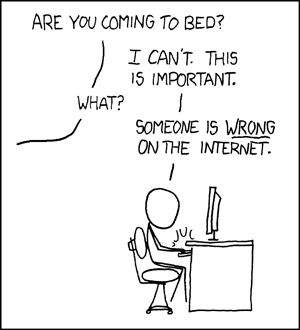
The blog in a nutshell

The blog in a nutshell
(From xkcd.com)

Monday, December 14, 2015

Today, the Court decided DirecTV v. Imburgia.   The case involved a pretty complicated contract, one not likely to be seen in the future, where the arbitration clause was dependent on whether state law permitted class arbitration.  Specifically, the arbitration states that if the “law of your state” makes the waiver of class arbitration unenforceable, then the entire arbitration provision “is unenforceable.”

At the time the arbitration agreement in DirecTV was entered into, California banned class arbitration waivers, making such waivers unenforceable. In 2011, the Supreme Court found all such bans preempted by the Federal Arbitration Act.  The question in DirecTV was whether the provision above applied to make the arbitration provision unenforceable.

One easy way to decide this case would be to find that California law did not make the waiver of class arbitration unenforceable at the time.  Under this theory, despite what the parties may have thought at the time, California law did not actually make waivers of class arbitrations unenforceable.  This would be because California law in this regard was invalid and had no effect.  Such is consistent with a long history that, when a court announces a new rule, they are merely finding it, not changing it.  

In fact, that appears how the Court wanted to decide the case.  But California courts held otherwise, and the FAA does not allow the Supreme Court to *interpret* California law.   It only allows it to invalidate a California rule of decision that discriminates against arbitrability (more about that when discussing the dissent).

Rather than accept the decision of the California Court--which is what the dissent suggested--what the Court did here was say that, in other cases, California would have interpreted a provision incorporating the law of a state to include yet-discovered changes to the law; they would have adopted the "finding law" theory I summarized above.  By not incorporating the law of a state to include the change here, California was discriminating against arbitration provisions - a no-no under the FAA.

There were actually two dissents.  Thomas dissented on his usual grounds in cases like these, arguing that the FAA does not apply in state courts.  Ginsburg, along with Sotomayor, separately dissented.   Nothing in this post touches on Thomas's arguments, so I refer to the Ginsburg opinion as "the dissent."

The dissent's position was essentially that all the FAA really bars is the invalidation of arbitration provisions by state law:  The FAA's text bars arbitration-specific rules that would invalidate provisions "evidencing a transaction involving commerce to settle by arbitration a controversy."  Here, the California Supreme Court was merely interpreting the provision, not invalidating it.

I think the majority probably got this case wrong, but for a slightly different reason.  (I will explain my qualification of "probably" at the end.)  The dissent is not entirely convincing because choosing to find an arbitration provision inapplicable is the same thing as finding it not "enforceable."  So I don't think the FAA is as quite as narrow as the dissent makes it to be.  Nevertheless, as the dissent does note, the hallmark of arbitration is consent.  And for the FAA to apply, there must be an intent in the contract "to settle by arbitration a controversy."  And I don't think that existed here.

At the time the contract was entered into, the parties knew California law applied, and thought (incorrectly) that California law barred class arbitration waivers.  Thus, they would have thought the arbitration provision was inapplicable.  The majority assumed they at the time the contract was entered into, the parties agreed to enter into a class arbitration provision, subject to the waiver clause, and only to the extent the waiver clause is valid, so that a change in law might snap the arbitration provision back at any time.  (Indeed, the slice of time they thought mattered as to what the relevant law was not when the contract was formed, or even when the breach occurred or the claim brought, but at the time of the California court's ultimate decision.)  While "meetings of the mind" are often more legal fiction than fact, it seems unlikely that the  parties were agreeing to was a convoluted, conditional arbitration provision.  I think a better way to understand the intent of the parties at the time was that, when the arbitration agreement would be governed by a state that's law did not enforce class arbitration waivers, the entire arbitration clause was not agreed to.  Or, in other words, let's say hypotheically that the California rule as it existed was also the rule in 6 other states, say NY, NJ, MI, ME, IL, and IA.  The agreement was simply shorthand for saying, "this provision does not apply in NY, NJ, MI, ME, IL, IA, and CA."  

After all, how would a non-class case have proceeded prior to the Supreme Court announcing the class-arbitration-waiver-ban unenforceable?  If the arbitration provision is initially valid, then the arbitrator would have to initially decide the issue (as it had to in Green Tree v. Bazzle).  So the arbitrator would have to decide this broad issue about class arbitrations.  Only once that was decided, would a state court be able to review the decision.  It is unlikely a person in California, thinking the arbitration clause would not even apply to them, were agreeing to such procedural hurdles to their contractual rights to bring a claim. 

And if the parties were deciding not to arbitrate in California at the time of arbitration, a change in law should not create the consent to arbitrate.  That would be true even if California law changed on its own, without prodding by the Supreme Court.  So the required consent necessary for arbitration never existed, and the FAA should not apply to compel arbitration in this case.

Indeed, the Court treats the State Court's decision as discriminatory against arbitration, and it is; in this case.  But in doing so, the Court creates a rule of interpretation that might be discriminatory based on other facts.  What if the parties entered into the same agreement today, and then Congress changed the FAA to explicitly bar class-arbitration waivers?  This is not entirely infeasible should Democrats again control Congress, as the financial reforms after the 2008 recession will likely lead to a ban on such waivers in financial contracts within the regulatory purview of the Consumer Finance Protection Bureau.  Presumably, the Court would hold that the arbitration provision was unenforceable in California, even as it applies to non-class arbitrations.   But it is possible that the California court may have found, in that situation, the parties, not anticipating this change in the law, agreed to arbitrate their claims, and although this does not include an agreement to arbitrate class claims, such a limitation is unenforceable.  Thus, the Supreme Court's decision would be the one discriminating against arbitration!  (The Supreme Court's decision would nevertheless be consistently pro-corporate, for those of you who take a more realist view of Supreme Court decisions.)

The reason I say "possible" is the same reason I said "probably," and it may make my entire analysis moot.  As I mentioned above, it is the California court's interpretation of the provision that matters, not my own.  And the California court did not explicitly adopt my analysis.  Rather, the California court said that it interpreted the provision to apply to California law irrespective of whether that law was pre-empted by California law.  So, to treat the California decision literally, it's not entirely clear the California Court of Appeals agreed with my interpretation, and, from the Supreme Court's analysis, it is that interpretation that matters, not its own, and not mine.  I do think its interpretation is consistent with mine, at least to the extent that both of us broadly found that the heart of the parties' meeting of the mind was simply "no arbitration provision."

But I don't think the Court was taking that detailed a look at things, so I can't be sure if it would have applied the "opposite" reasoning above in the reverse hypothetical.  While the text of that decision implies that it would not, I don't know if the decision should be read that broadly. One reason for that is because, once the Supreme Court ruled such class-action-waiver-bans preempted by the FAA, nobody would put such a provision in their arbitration clauses.   And the fact that such a provision would be eliminated does highlight the likeliness that the parties simply agreed to omit the arbitration provision, rather than to apply it the way the Court holds.  

The fact that such a provision would be eliminated for all post-2011 contracts also highlights the limited reach of this decision.  It simply is not likely to be one that ever repeats itself.  It's application required a confluence of events:  class-action waiver bans originally thought to be allowed under state law becoming retroactively barred by Supreme Court interpretation.  The only way for it to happen again is if the Supreme Court changes its mind on its own about that 2011 pre-emption decision, someone drafts a similar arbitration provision, and then the Supreme Court changes it back again.  Given how unlikely such a scenario this is, it is curious why the Supreme Court bothered to take this case in the first instance.

Thursday, December 10, 2015

General thoughts on the December sitting


Sorry for the lack of blogging.  It has been a combination of being very busy and, to be honest, nothing particularly noteworthy in the legal world for me to blog about.  That seems odd because there have been a number of high-profile cases recently argued before the Supreme Court.  But I don't have much to say about them:

Evenwel (the case challenging whether voting districts can be apportioned by person, rather than by eligible voter): The result here seems pretty straightforward as a matter of basic doctrine.  We live in a representative democracy.  The Constitution itself requires, for purposes of determining Congressional apportionment, for representatives to represent a certain number of people, not voters.  The legal arguments supporting the petitioner are incredibly thin.  The practical difficulties of the challengers' claim is highlighted by the fact that we do not even have good information about the number of eligible voters in most voting districts.  But, like the Voting Rights Act cases and others, this Supreme Court has found ways to make up doctrine as it suits them for what many would think is partisan advantage.  I'm afraid whether the Supreme Court finds for Evenwel or not will simply depend on how shameless it is.  

Fisher II (the Texas affirmative action case)- I think it has been pretty clear that the Supreme Court has basically constructed a rule about affirmative action that, ever since O'Connor left the Court, allows for de jure affirmative action in the abstract only.  So the only real question is how much more battered will the hopes of people who support affirmative action get.  I think the more interesting question is one put forth by Ilya Somin at the Volokh Conspiracy.  Prof. Somin argues that even facially-neutral affirmative action plans that have the  intent of increasing minority enrollment are unconstitutional.  (In Fisher, it is the Texas "10%" plan that guarantees admission to all Texas students who finish in the top 10% of their class.  It is not being challenged in this case.) I think this is actually a very liberal (and doctrinally incorrect) argument that would create very wide repercussions:  


First - Whether legislation can have an intent (as opposed to a purpose) is a difficult question in and of itself.  Conservatives believe that a drafter's intent is irrelevant, and legislation should be interpreted as a segregated reader would interpret text, rather than read text as the drafter intended.  Liberals disagree (but only as a guide for interpreting text).  Somin would go further and read intent into a bill even when there is no text.  And intent in passing a bill - as opposed to interpreting text in light of purpose - is an impossible thing to determine because intent may vary from person to person.  Someone may vote for a welfare cut because they want money for tax cuts.  Another may do it because they dislike the poor or minorities.  And a third may do it merely to get support on a different bill.  Is the intent of Congress in passing this welfare reduction a violation of the 14th Amendment under Somin's theory?

Second - It's a pretty well-established doctrine of law that judicial inquiry into the actual intent of legislatures (and executives passing government action) should be avoided at practically all costs.*  This is why the rational and strict scrutiny tests normally used to determine constitutionality of laws is objective, not subjective, in nature.  Stating that subjective intent matters would create a host of problems, ranging from questions of who gets to do the factfinding to what intent matters and when is something "too" racially motivated.

Third - If this rule applies to affirmative action, will it apply to regular laws as well?  Conservatives have panned disparate impact analysis in the context of Constitutional rights, and have generally won.  What Somin is arguing for is not quite disparate impact, but it is getting there.  And given the Conservative southern strategy (where Lee Atwater infamously admitted that cutting government spending was broadly an appeal to racists), how many laws will we have to invalidate?  Liberals and conservatives have recently excused them of looking for whatever reason around to invalidate the other's preferred laws (think gay marriage bans, health care, Voting Rights Act, campaign finance refom, state immigration laws).  With Somin's theory applied broadly, this will go from Pandora's Box being slightly cracked to busted wide open.  But if it is applied narrowly, minorities will rightly wonder if the Equal Protection Clause of the Constitution is only applied broadly when it is used against them, rather than by them.

(I reserve the right to a more detailed version of this critique in a follow-up post).

Hyatt:  Hyatt is a case that involves the question of whether and when states may assert sovereign immunity, as a matter of federal constitutional right, when being sued in the state courts of other states.

I actually think this might be the most doctrinally interesting of the December cases.  My gut (and completely uninformed) reaction is that the challengers asking the federal government to interfere in the state's judicial proceedings itself sort of violates a form of federalism.  In that sense, I'm not even sure the case is procedurally ripe.  Instead, I think the federal court should essentially stay out of it until the state of Nevada takes a specific action *against* the state of California independent of merely announcing a rule of decision in its judiciary.  Should the state of Nevada try to attach or seize California's assets, then California could go and challenge that action - in an Original Jurisdiction case - before the Supreme Court.  And, in doing so, I think the sovereign immunity claim can be better distilled and applied when there really is a sovereign interest at play that must be vindicated by our Constitutional structure.

*In some cases, such as using pre-emptive strikes against black jurors, the test cannot be subjective.  Even then, we've seen, Courts have been reluctant to overturn even the most obvious of intentionally-racist acts that can be objectively defended.  

Friday, November 20, 2015

The Politics of Refugees and Bigotry

This is normally a law blog, but I am going off topic for a moment for a little self-therapy.  You see, I am in despair over the immediate turn towards bigotry in the wake of the Paris attacks.

There are over 4 million Syrian refugees registered with the United Nations.  These refugees live in a state of desperation, fear, and need, that most people (including myself) cannot possibly imagine.  Contrary to belief, they are not mostly men.  Instead, they are mostly women and children; only 11% of the 5 million are men of potential fighting age.  


They need help.  

The United States agreed to take in 10,000 of them over the course of a year.  That's  slightly more than 0.2% of the total.  It is a pittance, but at least it is something.  Even if the United States renewed that 10,000 person commitment for 10 years, that would still be 2% of the total population.  It is the least we could do.


One would think.

Numerous governors, mayors, Senators, and others have railed against taking *any* refugees.  Others have--naked in their bigotry--said they we should only take Christian refugees.  This has been mostly pushed by Republicans, but Democrats, either because they are equally ready to cash in hatred, or because they are too afraid to do the right thing, have also joined.  The House recently passed a bill which would effectively prevent any Syrian refugees from entering the country, by veto-proof majorities.  Hopefully the Senate will be more circumspect.

Let me make this absolutely clear:  The refugees pose no significant risk of harm.

First, the numbers:  There have been 784,000 refugees resettled into the United States in the last 15 years.  I do not know how many of them are Muslim, but given where the wars have happened recently, probably alot.  There have been exactly three terrorist plots uncovered among the 784,000,  and none of even those 3 posed a serious threat to America.  (In addition, I am aware of a handful of refugees who have been arrested for supporting ISIS; these were six refugees from the ethnic cleansing of Bosnia and one refugee rom the non-religious wars in Somolia.  None were recent--post-2000--immigrants, none had any ISIS or terrorist connections prior to coming to the United States, and none were seeking refuge *from* Islamic extremism, either Sunni or Shiite).


Second, the logic.  These are people who are *fleeing* ISIS.  They are not exactly people who are taking up ISIS's banner.  Most of them are likely fleeing because they are not radical Sunnis.  None of them are going to take up ISIS's cause, because if they were sympathetic to ISIS, they would not be fleeing.  

But what about some false flag campaign?  What if ISIS implanted fake refugees among the real refugees to access the United States and ultimately commit an act of terror?  Although a fun plot for the reboot of 24, it is absurd as a matter of logic.


Let's say you are ISIS, and you want to attack the country.  The easiest way to do that is to recruit Americans, of course.  Then you don't need to sneak anyone in.  (The attackers of Paris were all EU citizens, as far as we are aware). But let's say this is super top secret, the Americans kind of infiltation, and you can't risk recruiting Americans.  You need to embed a local.


Well, if you are going to do that, the refugee program seems like the absolute worst way to do that.  A refugee would be one of 5 million people who has fled the country.  The majority of them are living in official and unofficial refugee camps in Lebanon and Syria.  So you put your high value infiltrator there.  They have to live in squalor, risk death, disease, violence.  But let's say they survive that.   Then they have to apply for resettlement.  

Most likely, they have to apply through the UN refugee system.  But one can't be picky about where one gets refugee.  A refugee who is only interested in the United States won't pass the United States's vetting system.  And if the refugee-infiltrator wants the United States, they'll probably have to at least bring their family; a single military-aged male seeking refuge by himself is someone the US can easily avoid when deciding which people to take in. 

Okay, so that person now has precisely a 0.2% chance each year of being taken in by the United States.  To get that number up to a reasonable amount, you need more than one infiltrator, you need to separately have hundreds.  All to get maybe one or two terrorist families into the United States.  And at the cost of providing the government with significant details about yourself, where you have been resettled, etc.  Yes, the screening system is not perfect .  But it doesn't have to be perfect to adequately deter.  The screening and follow up effort still provides the government with a lot of information about your existence and location. This is not exactly an inconspicuous way of getting into the country.  Even if you get in, you're still being watched pretty closely.

If the US was a fortress impossible to impregnate, then, okay, maybe.  I mean, unlikely, but maybe.  But we are not.  Our borders are notoriously porous.  If you want to get a Syrian terrorist in, and you're willing to risk only getting in a percentage of your whole team, then you can send em through Mexico. Sure, they might be caught, but their odds are alot better than 0.2%.  You find Syrians with non-Syrian passports who can get tourist visas into the US.  The 2001 attackers did not need to come up with a convoluted plot to get into the country.  

So letting 10,000 Syrians suffer and die because of our terrified imaginations is not logical.  Sure, the risks are not zero - there is nothing in life where the risks are zero.  But a zero tolerance for any risk is bad policy, and a standard that we have never applied to any other situation.  


Instead, the opposition to the refugees are probably the product of one of several causes:


I am aware that there is a certain ugly strain of political thought these days that demands tolerance of the intolerant.  So we have seen Democrats chide other Democrats for not respecting those that fear the refugees.  Mockery may not be helpful - it may, instead, merely be cathartic to those like us whose fear is the atmosphere of fear and hate itself. 

But, even if liberals take a political hit, and they will, they can't deviate from an absolutist position against the politics of fear.  The cost goes beyond the 10,000 lives at risk right now.  It also creates an atmosphere of hate and bigotry that can have enormous repercussions.


Let's not repeat the past.  Please.  Seriously.  And let's not give the jihadists exactly what they want, and turn this from a battle between Western powers and 100,000 or so dedicated jihadists, into a war between 1.6 billion Muslims and the 3 billion plus Christians, secularists, Jews, etc. who they want Islam to be at war against.

Now, back to your regularly scheduled programming.... (probably after Thanksgiving...)


Monday, November 16, 2015

RFRA, Hobby Lobby, and the Texas Abortion Case: Indirect for Thee, but not for Me

Recently, the Supreme Court granted certiorari (agreed to hear) an abortion case.  Petitioners in that case are challenging two Texas laws which regulate abortion providers in very technical ways.  Specifically, the law requires providers of abortion to have hospital admitting privileges in local hospitals, and requires abortion-providing facilities to meet the standards of "ambulatory surgical centers."  I don't want to get into the merits in this post, and so these details are not very important.

I don't want to get into the merits of whether there is a constitutional right to abortion. What interests me about the claim is the relationship of the claim to the constitutional right.   The right to abortion in Casey and Roe does not belong to the provider of abortions: there is no right to *provide* an abortion.  Instead, the right belongs to the person seeking access to abortion.  And the law does not directly regulate those people.

The claimants thus make the argument that the burdens on abortion provided by these Texas laws unduly burden the right of potential patients to have an abortion.  Thus, although the briefs debate whether the regulations are appropriate themselves, they also delve into the question of whether the result of the law would be to close enough abortion facilities to act as an undue burden on people seeking abortions.

I think these "indirect" constitutional rights cases raise interesting questions that go beyond a right to an abortion.  They also relate to other rights in other contexts.

One example comes to mind.  The example came up significantly during the Hobby Lobby debate.

As you are probably aware, one of the fundamental questions was whether corporations could have their religion "substantially burdened" under RFRA and thus obtain protections under the Act.  In what seemed to me like an overly-black-and-white analysis, many advocated that corporations can't practice religion.  That argument, it would go, is that when one acts through legal separateness, one has to legally separate their own religious beliefs through the artificial entity one created.  If one accepts the benefits of limited liability, one has to obtain the costs as well.

The argument in favor of corporate RFRA rights often focused on non-profits, which I think is a little besides the point, since one can easily make a distinction for, say, a Church.  The purpose of a non-profit in corporate separateness is different than for-profit corporations (indeed, in only one state, Kansas, do non-profits have shareholders; in others, they typically have membership, but are not "owned" even when they are controlled).   But the smarter counter-argument was that individuals exercised religion *through* corporations, and that the line-drawing between a Church and a private, for-profit entity is not so easily distilled.

That's right, of course:  A privately-held company is on a sort of continuum.  A church is at one end of that continuum (let's put religious universities and schools and other entities that are not designed to earn any money other to pay for its operations in the same category).  A non-profit gift shop designed to support the Church is next.  Then, say, a for-profit wedding chapel with a specific religious purpose, run by an ordained Minister.  Then, a kosher shop.  At some point you reach a for-profit company like Hobby Lobby (or, say, Chik-fil-a), which is run primarily for profit but wants to incorporate Christian values, even at the expense of profits.  At the other end, a public company (like Coca-Cola) that is owned by shareholders with diverse religious views, who presumably cannot exercise any religion, and, to the extent that directors and officers try and use the company to exercise their own religion, might be violating their fiduciary duty to those shareholders.

As a result, the more narrow argument ends up arguing that, while corporations do not have religious rights, corporations are fictional entities.  They are run and managed by directors, officers, shareholders, and employees.  And a regulation aimed at a corporation can have the indirect effect of infringing the religious liberties of the individuals who run them.   Under this argument, the response to the liberal argument is that while individuals give up certain rights when undertaking the corporate form, their First Amendment right--and the statutory rights under RFRA that incorporate Congress's understanding of them--are not one of those rights.  I think is actually pretty fair, as running a company of significance without using some form of limited liability structure these days is near impossible, so that asking religious people to make this choice is tantamount to requiring religious people to refrain from entrepreneurship.

The Court accepted this more narrow argument, explicitly.  And I don't think this was wrong. But instead of then crafting some sort of test to determine whether the regulation of the (non-religious) corporation creates an indirect undue burden on the rights of the individual, the Court just went on to assume that a closely-held owner of a corporation can imbue the corporation with its own religious beliefs, like the Jewish gollum.

As you can tell, I think this is where the Court went too far.

As I mentioned before, once the Court held that Hobby Lobby and its co-plaintiff, Conestoga Wood, had religion, it accepted the truth of the allegation that this religion was substantially burdened by having to purchase insurance which included abortion.

I think I would have taken a quite different approach.  Again, in light of my earlier post, I would have required Hobby Lobby's owners (the Greens) and Conestoga Wood's owners (the Hahns)* to identify exactly what about the contraception mandate violates their religious belief; "complicity" is not enough.

1) Is it merely paying money that would ultimately be used for contraceptive services?  If so, it's unclear whether that is actionable or not.  After all, I suspect the Court will not grant relief to a religious pacifist who refuses to pay taxes because the money will be used for war.

2) Is it the act of approving contraceptive use?  Technically, neither Hobby Lobby nor Conestega Wood have the ability to forbid it, so nobody is approving it.  And neither company processes any claims themselves; instead, Hobby Lobby's third-party administrator processed Hobby Lobby's payments on HL's behalf, and CW's third-party-insurer processed that third-party insurer's payments, If the companies did, then the next question is whether the Greens and Hahns are actually affected, because it is unlikely that they themselves processed any payments.  Sure, their employees did.  But how involved were the Hahns?  And to the extent they were involved, did they have to be? Could they have delegated it to their employees?  I say this because I think it is unlikely that the Hahns have the right to discriminate in employment based on religion (at least absent a sincerely held belief that hiring outside of their religion substantially burdens their religious beliefs generally, and, according to the Hobby Lobby majority, even with such religious belief, at least with regards to race), and if they do not, it raises a question of whether the Hahns have any legally-cognizable interest in their company's employees acting in conformity to their own religious practices.  I am not asking these questions rhetorically - I think these are difficult questions that a Court actually does need to resolve if they come up.

3) Perhaps it is directly paying for the contraception itself.  In that case, Hobby Lobby does indeed pay out claims, as they are self-insured.  And, since it is closely-held, the Greens are effectively paying them out as well.  I think, when all we are talking about is money of a for-profit entity, the question of the corporate veil is closer, and might win the day even when I think it shouldn't automatically prevent a RFRA claim in other circumstances.  But that's a closer case, so maybe the Greens' rights are burdened.  But still, the Hahns' aren't.  Conestoga Wood, IIRC, is not self-insured, and although it pays for insurance that includes among its bundle of options contraception, the insurer pays for the contraception.  Although that adds to the cost of the insurance product to Conestoga Wood, I do not think that's a direct enough relationship to allow the Hahns to object without also allowing our pacifist taxpayer friend to get a huge anti-war exemption.  So it is certainly possible that Conestega Wood could have lost even had Hobby Lobby won.

(The Court simply refers to the "funding" of contraception, and thus does not need distinguish between alleged right 1, which I think is untenable, and right 3, which I think is far more persuasive.)

The broader point is that our Constitutional system is not quite so rigid as to not make room for broad notions of indirect rights.  Nor does it need to come up with rules, like in Hobby Lobby, that transformed indirect rights to direct rights at the snap of fingers.  If that's the case, then we should just assume that the abortion providers in Texas can assert a right to provide abortions, and avoid that issue entirely.  That can't be the case, so the Court should not simply hold certain indirect rights to be more "direct" than others.  Doing so will invariably allow the Court to pick and choose which constitutional rights it wants to enforce broadly, and which it wants to practically eliminate.

One last point.   Considering the indirect rights of *individuals* could resolve some of the problems that came up had the Court held that individuals were not allowed to practice their own religion through their for-profit corporations.   A popular example in the blogosphere was the question of whether a rule requiring all supermarkets to sell beef would violate the rights of kosher stores.  It is at least arguable, however, that even if a private individual did not have a legal religious right to operate a kosher store through a for-profit corporation, such a rule might violate the religious rights (and Equal Protection Rights) of the store's customers.  Likewise, requiring a Church gift shop to be open on Sunday, or a Catholic Church to hire female or gay priests, is arguably undue interference with the rights of individual churchgoers to have access to their Church.   Such use of indirect rights to solve the corporate form problem would also benefit from Courts treating the interference-with-religion/least-restrictive-compelling-interest tests as a single balancing test, which the Court has seemed to have done regularly both pre and post Smith, but has never formally acknowledged.  

*Note that in both cases each corporation had multiple owners.  In this case, the religious beliefs were alleged to have been the exact same among all owners.  But Hobby Lobby posts interesting questions going forward regarding a company in which the beliefs vary among co-owners.   Is it just the interests of the majority shareholders?  Even in a publicly-held corporation?  If so, at what point does the majority owner violate its fiduciary duty to the minority owner?

Tuesday, November 10, 2015

The Slippery Slope that is Hobby Lobby Is Only One Step

As you may have read, the Supreme Court is taking up the question of contraception coverage under RFRA again.  There are 37 different parties challenging the government regulation in question, and so the factual nature of each claim is slightly different.  But I think each of the challenges share the same fundamental flaw. Specifically, the challenge only can succeed to the extent the Court allows the challengers to the law to phrase their argument as the challengers select, without questioning whether the challengers are really making a different, quite indefensible, argument.  And, for reasons I will explain, I do not think RFRA requires this.


RFRA, the Religious Freedom Restoration Act, is essentially a statutory rule of interpretation.  The Act was designed to overturn a decision of the Supreme Court (written by Scalia) called Employment Division v. Smith.   Scalia, who has a habit of making dire warnings which sometimes comes true (Megan McArdle once joked that Paul Krugman has predicted 8 of the last none recessions, and I think it is fair to say that Scalia has predicted 100 of the last 12 major legal breakdowns), accurately noted that a rule which allowed individuals to "opt out" of generally applicable laws for religious reasons would lead to chaos (citations and emphasis omitted):

"To make an individual's obligation to obey such a law contingent upon the law's coincidence with his religious beliefs, except where the State's interest is 'compelling' -- permitting him, by virtue of his beliefs, 'to become a law unto himself,' contradicts both constitutional tradition and common sense....


Any society adopting such a system would be courting anarchy, but that danger increases in direct proportion to the society's diversity of religious beliefs, and its determination to coerce or suppress none of them. Precisely because 'we are a cosmopolitan nation made up of people of almost every conceivable religious preference,' and precisely because we value and protect that religious divergence, we cannot afford the luxury of deeming presumptively invalid, as applied to the religious objector, every regulation of conduct that does not protect an interest of the highest order."


Unfortunately, Congress ignored this warning and enacted RFRA, which creates a presumption in each law by Congress that the law does not apply in individual instances to the extent it creates a "substantial burden" on an individual's religious rights, unless doing so is "in furtherance of a compelling government interest," and "is the least restrictive means of furthering that compelling governmental interest."


Hobby Lobby, the first contraception case, notoriously extended the right of "individuals" to for-profit corporations, and I do not want to get into the merits of that point here.  But it also did something else.  The language quoted in the statute describing the least-restrictive/compelling interest test from RFRA comes from the language used by courts in pre-Smith law, when there was a First Amendment religious liberty exception to generally-applicable law, but it does not accurately reflect how the Court ruled on those claims.  Instead, the Court applied something more akin to a balancing test, which allowed the Court to generally enforce (taken from Smith itself) compulsory military service, tax law, child neglect law, vaccination law, drug laws, traffic laws, social welfare laws, child labor laws, animal cruelty laws, environmental protection laws, and civil rights laws, even though in almost all of these cases, it's easy to show that the government interest in the law could have been done in a slightly different way, which perhaps might not have "infringed" on the practitioner's religious interests quite so much.  But Hobby Lobby took Congress literally, and untethered the language from the pre-Smith caselaw.  

Further complicating this is how Courts define the burden of religious exercise.  Under the Supreme Court's analysis, other than a sop to sincerity that rarely goes enforced, one cannot question the truth of the individual's religious claims.  To some extent, that's fair:  If someone wants to go to Church to praise Jesus, a Court obviously shouldn't say they have no religious interest because, really, everyone knows that the Flying Spaghetti Monster is the one true God.  Nor should the Court be judging religious doctrine:  If someone thinks their religious interpretation of Judaism allows them to eat pork but not leavened bread on Passover, it's not for Courts to interpret religious doctrine.

But Hobby Lobby went too far in a different way - it allowed the petitioner to not only phrase the religious belief without question, it also allowed no inquiry into the scientific facts as they apply to the religious belief.  In Hobby Lobby, the plaintiffs did not claim that contraceptives qua contraceptives violated their religious beliefs (and, indeed, did not object to all contraceptions).  Rather, they objected to that abortifacients violated their religious beliefs, and providing coverage for certain contraception meant providing abortifacients.  The problem--ignored by the Courts--was that this was false, and that the contraception that Hobby Lobby objected to were, scientifically speaking, not abortifacients.  

Post Hobby Lobby, all a religious objector really has to do to opt out of the contraception coverage is....to opt out (seriously, go look at it).  Specifically, they have to fill out a form stating that they object.  Then, HHS - without involving the objector at all - works individually with the insurer or administrator of the insurance in providing contraceptive coverage for the objector's employees.  But even this scheme has led to another round of challengers.

The new challengers cause a wholly new problem with how the Court unquestioningly allows the petitioner to frame the religious question.  And here, I think, the Court goes too far.

Let's go to the Eighth Circuit decision (the one which found for the challengers, leading to a circuit split):  


"CNS and HCC contend that the government is coercing them to violate their religious beliefs by threatening to impose severe monetary penalties unless they either directly provide coverage for objectionable contraceptives through their group health plans or indirectly provide, trigger, and facilitate that objectionable coverage through the [form] accommodation process."

In other words, they aren't objecting to the form itself, although lazy journalists have used that terminology.  Of course not:  the Catholic Church does not have a prohibition on forms!  Instead, they are objecting to the fact that a) they have a legal obligation to provide unobjectionable health care, which in turn b) allows Congress to arrange objectionable health care for their employees, but c) If they don't provide any health care, they would be on the hook for a big fine, but their employees would remain uncovered.  


Although the law doesn't technically treat the requirement to provide unobjectionable health care as a choice, these challengers are taking advantage of the fact that the side-effect of non-compliance is preventing their employees from getting (objectionable) health care, as well as huge fines.   From their view, Congress is allowing them to decrease the number of people who are provided objectionable health care (by breaking the law), but only at the cost of a huge fine; which in turn, according to the challengers, should allow them to be excused from the law itself.  

One does not have to challenge their religious convictions to look critically at their claim of substantial burden.  The burden they claim is not a burden on themselves.  Rather, they claim a religious freedom right to prevent their employees from obtaining health care coverage from others.  And this is a right that, even under RFRA, cannot stand.  Religious Jews can't claim a religious right to be exempt from anti-theft laws if they decide that nobody should eat pork and therefore go around destroying all the pork.  And a Religious Jewish employer can't go around refusing lunch breaks to their employees because the employees might go to the local BBQ Rib joint on the break.  That's not how democracy *or* freedom works.

And yet, if one has to accept the claim that even providing health care under the ACA at all violates their religious beliefs so long as the net result of compliance is more people covered for contraception, this claim would pass muster, and go up against the Hobby Lobby least-restrictive/compelling interest test, which, when used in other contexts (such as the Equal Protection clause) is almost always fatal to any regulation at all.  


The solution, of course, is to overturn Hobby Lobby's decision to defer entirely to the challenger's characterization of what infringes their religious beliefs, as well as the decision to depart from the pre-Smith meaning of the least-restrictive/compelling interest test.   As soon as we make any inquiry into that characterization, two flaws immediately appear:

1) The employer's interest in seeing that their employees are denied health care can be seen as the real "religious liberty", and we can deny this as a legitimate interest protected by RFRA in the first instance; 


2) There is no "less restrictive" way of the government providing the contraception care in this instance which does not substantially burden the challengers' religious liberty because it is the providing of that care which creates the coverage, and under the challengers' own theory, they would be complicit in any event because the employing of the individual is what creates the coverage in question.

This does not require challenging the employer's fundamental religious conviction that contraception are bad and that the employer should not be required to do anything complicit in providing them.  It instead merely requires that Courts look to see whether the religious interest asserted by their "complicity" is really a "liberty" interest at all.  It also - to a lesser degree - requires a Court to balance the supposed interference with the religious interest with the government's interest generally (not just in providing contraceptive coverage but providing health care) as well as with any proposed alternatives that the objector suggests.  But I think this was what was always done, practically if not explicitly, both in pre-Smith cases and in pre-Hobby Lobby RFRA cases.

The Eighth Circuit opinion, instead, notes that once the government has conceded that the interest is sincere, the Court's inquiry regarding whether the government's action burdens that interest is at an end, because we must take the challengers at their word that their religious interests are being burdened, even though the challengers are often evasive as to what, exactly, burdens their religion.*  It then goes into the least-restrictive/compelling test merely by noting that the government has the burden of proving the lack of any alternative--something that is essentially unprovable.  It should be the burden of the Plaintiff - and the Court - to at least *suggest* an alternative.

The Court lists only one "least restrictive" alternative that the plaintiffs use a different way of opting out (one that does not provide the identity Third-Party Administrator to the government, although my own reading of Form 700 does not indicate this is even required).  Really?  Does the Eighth Circuit really think that the real problem with the notice was that the form asked them who the third party administrator is?  While one could mock the merits of that argument-filling the form out in English instead of Latin does the government a really-unwelcome solid-do you think the challengers would think of themselves as huge victors if they only could refuse to provide that one detail?  And do you think anyone has really won out if the government now has to  bear the costs of discovering this information (imagine the job posting - a Third-Party-Administrator-discoverer!).  It should be worth pointing out that there are cases where other challengers did not have to provide that information, and the Supreme Court decided to hear those cases along with this case.

Again, the case can be easily disposed of once one critically identifies the (sincere) religious objection that is *actually* being made.  The challengers want to deny their employees contraceptive care.  Not being complicit in providing contraceptive care is not the same thing as being permitted to deny others their right to obtain it from a third party.  Otherwise, watch out, because I can destroy your pork.

And, going forward, the Court must either put some limits on how challengers phrase RFRA, or alternatively revisit its decision in Hobby Lobby to treat the least-restrictive/compelling interest test in an essentially-fatal way.  Otherwise, the law becomes subservient to religion generally, with any challenge to government action (civil or criminal) simply be a bare assertion that the action infringes on liberty, which can neither be challenged nor reasonably overcome in almost any instance.


*All that is really said is that they are forced to be "complicit" in providing contraceptive care burdens their religion.  But what "complicit" means is hopelessly vague.  


Tuesday, November 3, 2015

Where I pat myself on the back because why not


JUSTICE SCALIA:  I assume that the person read this and ­­ and thought that that's what it meant. MS. O'CONNELL:  And ­­ and, Justice Scalia, I think that's why the canons of interpretation don't get anybody a hundred percent of the way there.
JUSTICE SCALIA:  I agree.  And what I worry about is the rule of lenity.  You have these dueling canons, and you have a rule that when the government sends somebody to jail for ten years, it has to turn sharp corners.It has to dot every I and cross every T.  It has to be clear.  And, you know, we've been discussing this dueling canons and so forth.  My goodness, I have no assurance what the right answer is.  But I know that somebody could read this and think that it means what the petitioner says it means.  And if the case, it seems to me the rule of lenity comes into play.  That's ­­ that's what concerns me most about this case, not the dueling canons.


 JUSTICE BREYER:  What were the ­­ what were the other three?  You said there were four reasons.  I started where I think Justice Scalia did.  Of course, I  might more often than he think that the canons don't help us all that much.  And this ­­ this is a poster child, I think, for that proposition.


 JUSTICE SOTOMAYOR:  I mean, your brief and the solicitor general's sort of tunnel in on this one provision of many.  But I'm wondering why? I'm looking at the entire provision [and it] has many State court analogues that don't involve interstate commerce, correct?


JUSTICE BREYER:  The basic point is I counted ­­ made an effort to count these.  I accept your argument there are about ten of these sections that ­ you know, you you couldn't use that as a limitation.  But if I look at those ten individually, I will discover that ­­ Congress did want to pick up State crimes there or they don't use exactly jurisdiction language like evade a tax imposed under this title.
MS. GOLDENBERG:  Yeah.
JUSTICE BREYER:  And it isn't really going to be the anomaly I thought it was. 


When you're an Article III Hammer, Everything is an Article III Nail

So I reviewed the oral argument transcript in Spokeo v. Robins, and I noted an unfortunate thread in some of the questioning.  Much of the questioning was of the "slippery slope" variety, in that there was a concern that if courts allowed claims to be green-lit by an unscrupulous Congress, which would cause fundamental unfairness to future potential defendants.  These questions often proceeded by hypothetical.

Here are some examples  (I've made minor edits to the transcript for readability only):

First, on page 30 of the transcript:

CHIEF JUSTICE ROBERTS:  What about a law that says you get­­ $10,000 statutory damages if a company publishes inaccurate information about you?  You have an unlisted phone number.  You don't want people calling you.  The company publishes your phone number, but it's wrong.  That is inaccurate information about you, but you have no injury whatever.  Can that person bring an action for that statutory damage?

The key to Chief Justice's hypothetical here is the $10,000 statutory damages.  The damages seem untethered to the conduct.  This not an entirely non-existent problem already. 

Here's another (pp. 42-43).


CHIEF JUSTICE ROBERTS:  But I want to ­­ as I understand, I take the falsity out of the ­­ the hypotheticals to get exactly what your position is on the breadth of Congress' power.  So let's say the  statute says anybody who's publishing information about you has to pay the individual $10 a year.  They think that's a good way to regulate it.  It's information about you, good, bad, or indifferent, pay them $10 a year, no more, no less.  Spokeo or whatever that business is pays you $20 one year.  Now you've been ­­ the statute has been violated with respect to you, a particular individual.  Can that ­­ and there's statutory damages of $10,000.  Can that individual sue? 

Here, the keys underlying the question is whether (a) the right to $10 a year is legal in the first instance, (b) whether the "no more" rule is arbitrary and capricious, and (c) whether the $10,000 is a fair penalty.


And here's a third (p. 50):

 CHIEF JUSTICE ROBERTS:  Mr. Stewart, let's kind of say your ­­ your ­­ Congress thinks that the president is not doing enough to stop illegal immigration, so it passes a law that says, anyone in a border State ­­ so it's particularized ­­ who is unemployed may bring an action against an illegal immigrant who has a job.  And they get damages, maybe they get an injunction.  Can Congress do that?

Here, the keys involve whether Congress can bypass executive authority to enforce the law, and whether an individual can be awarded for damage an individual does to society.

Underlying these concerns there are three issues.

The first is the incorrect assumption that Article III provides a substantive limitation on the power of Congress. I mean, it's right there in hypotheticals 2 and 3.  But Article III does not provide power to Congress, but instead power to the Judiciary.  The  Chief Justice ignores that a ruling for Spokeo would not eliminate these potential slippery slopes, but merely require them to be brought in state court (and, of course, allow state law to decline to hear them as well).  They would not change the statutory right; they would just eliminate a federal forum for resolving that right.  Indeed, the Act at issue in Spokeo here preempts state defamation law (p. 41).  So instead of bringing a state-law claim for defamation, they would have to bring a federal claim under the Act in state court.  And the defendant could not remove the case to federal court because there's no jurisdiction!

The second is a distrust of Congress. In each hypothetical (except perhaps the 3rd), the Supreme Court assumes that Congress will do something bad for no good reason whatsoever.  Likewise, tt assumed that in the ACA cases, threatening to strike down the Act because of a fear that Congress might enact a broccoli mandate.  But part of the Constitutional process involves Congress itself.  And while the Constitution provides additional protections to minorities whose rights are likely to get trampled on by the majority, the majority's biggest protection of rights is the democratic process itself.

The third is that conservatives do not like substantive due process.  Their concerns about it include a variety of good reasons and bad reasons that I do not want to get into here.  But while they don't like substantive due process, their feelings often change when the result is striking down anti-libertarian laws.  Yet, hampered by their dislike of due process, they often try to accomplish due process rights by looking at other parts of the Constitution.  In the ACA, it was the Commerce Clause.  In Spokeo, it is Article III.  In both circumstances, however, the protection at issue is clearly only a protection from federal regulation, inapplicable to the states, even though the state accomplishing the same thing would be just as offensive as the federal government doing it, from their prospective.

In fact, these hypotheticals do touch on constitutional rights.  But they aren't Article III constitutional rights.  And the rights that they do touch on would protect individuals from the state government and the federal government alike.  Thus, these unlikely hypothetical issues can and should be resolved without creating new rights. 


Let's start by looking at hypothetical 1.  The person has had improper information published about him.  Sure, he might not actually mind - he doesn't want to be called anyway.  But that requires a subjective reading into his brain, and most people might actually mind.  They just might not mind to the tune of $10,000.  

Now, Congress would almost certainly never pass such a statute.  But let's assume they do.  If the $10,000 damages is disproportionate, it may raise due process issues.  As explained in a 1919 case titled  St. Louis, IM & SR Co. v. Williams, the Court noted that of course a government can impose a penalty.  "Nor does giving the penalty to the aggrieved passenger require that it be confined or proportioned to his loss or damages; for, as it is imposed as a punishment for the violation of a public law, the legislature may adjust its amount to the public wrong rather than the private injury, just as if it were going to the State."  But the Court went on to explain that a penalty might still violate the Due Process Clause of the Constitution when it is "so severe and oppressive as to be wholly disproportioned to the offense and obviously unreasonable."  So, if this hypothetical violates the Contitution, it does so because of that substantive due process rule.


Hypothetical 2 is actually quite similar, except by eliminating the requirement of falsity, it throws in some additional First Amendment issues that are not worth going through here.  

Hypothetical 3 involves other concerns, including thorny issues about the primacy of the executive in enforcing immigration law, whether the Constitution gives the federal government certain police powers, and, in doing so, whether it allows for private prosecutions.  Let's just say whether an individual can ask for injunctive relief to enforce immigration laws generally would be a very interesting question - one in which Article III would play almost no role at all.  As far as whether the plaintiff could bring statutory damages in this case, the answer would probably be no, not only because of St. Louis above, but because, under a case called State Farm v. Campbell, the due process clause holds that a "defendant should be punished for the conduct that harmed the plaintiff."   Punishment based on harm to damage to the society at large "creates the possibility of multiple punitive damages awards for the same conduct; for in the usual case nonparties are not bound by the judgment some other plaintiff obtains."  I say probably, because it is possible that, if the injunction is allowed, the Court may allow damages so long as those damages are merely adequate to compensate the plaintiff for its work.

But again, these are substantive due process issues, not Article III issues.  If they were Article III issues only, then the most that could be said about them is that the claims must be brought in state court.  And, to the extent that they are a restriction on Congress's power generally, they are not a restraint on the powers of the 50 state legislatures.  An Article III solution would not fully prevent the harm implied by the hypotheticals.

Conservatives do not like substantive due process in part because it allows the judiciary to read its preferred policies as a super-veto on legislatures.  This point is often valid.  But doing so based on the Commerce Clause or Article III poses the same problems.  And, unlike the Due Process clause, the singular focus on the federal government creates gaps allowing the concerned harm in any event.

This case involves the Fair Credit Reporting Act.  The Court's conservatives have pointed out some significant unfairness with the Act, including the fact that it is possible to read the statute to allow a plaintiff to sue a credit reporting agency with bad practices even if the bad practices do not lead to any error at all.  (Plaintiffs and the Government have conceded such a claim should not be allowed, and while I suspect that is right, I would prefer this be due to an extension of State Farm instead of through Article III).

But first, let that unfairness be tested among rules that apply broadly to favored and disfavored defendants alike.  What is good for a corporate defendant should be equally good for the guy using Limewire.  And second, if the concern is proportionality, use a part of the Constitutionality that allows proportionality to be considered.  Article III, on Spokeo's own terms, is an all or nothing proposition.